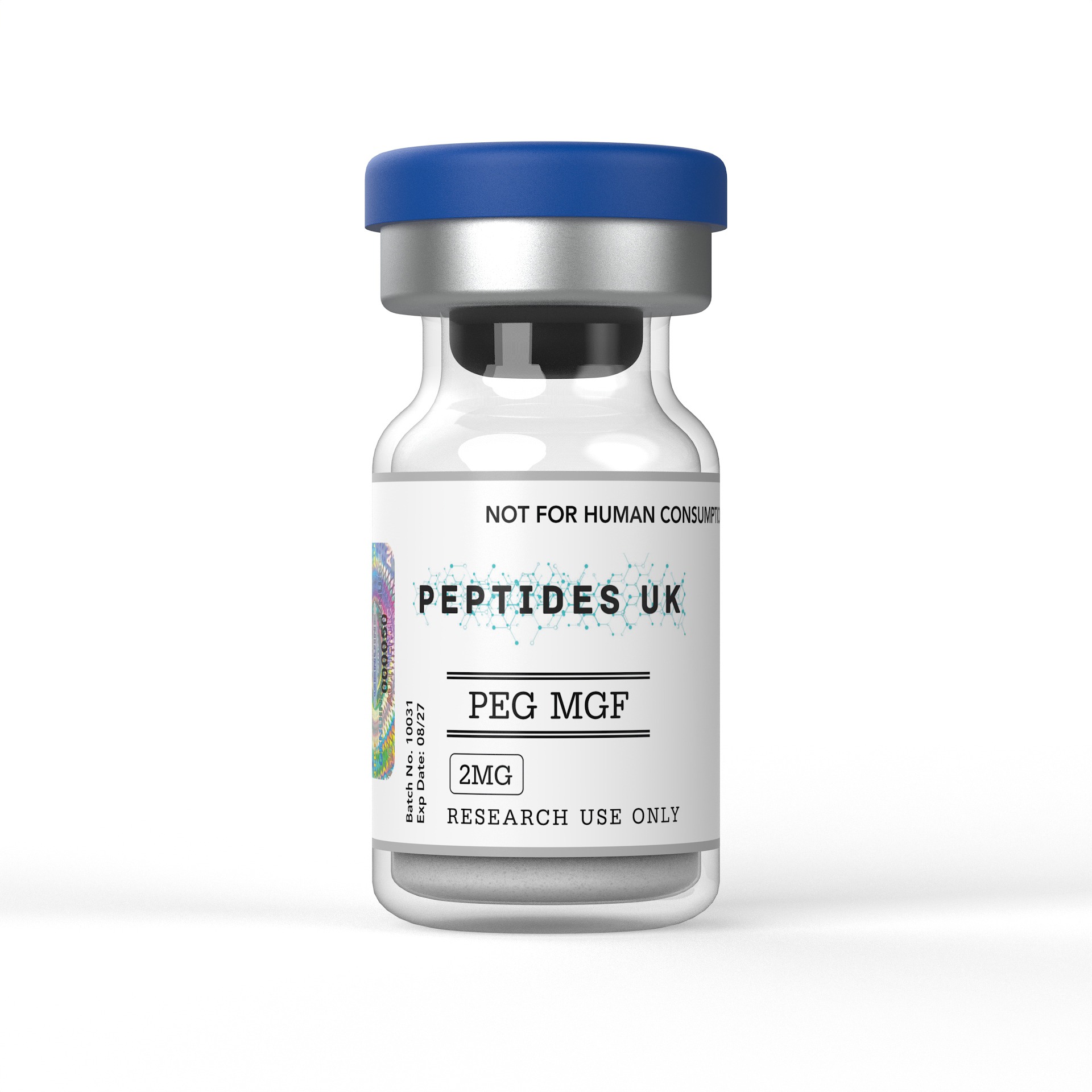
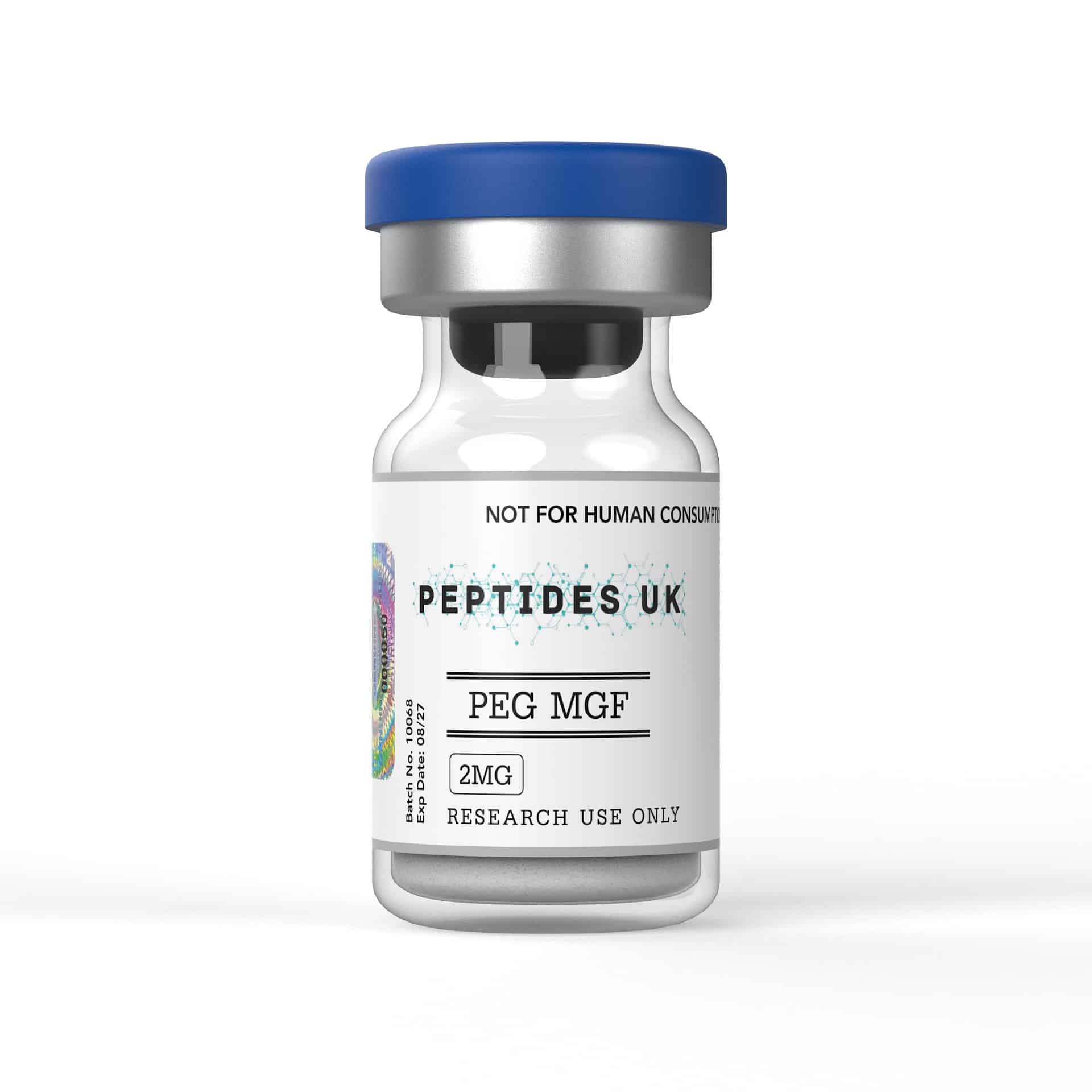
PEG MGF — Research-Grade Peptide | Buy PEG MGF in USA | ≥99% Purity
PEG MGF (PEGylated Mechano Growth Factor) is a research-grade IGF-1 splice variant peptide used in laboratory studies to investigate muscle satellite cell activation, tissue repair signaling, and mechano-sensitive growth pathways — available to buy in the USA with fast domestic dispatch and batch-specific Certificates of Analysis.
✅ ≥99% Purity — HPLC & Mass Spectrometry Verified
✅ Batch-Specific Certificate of Analysis (CoA) Included
✅ Sterile Lyophilized Powder | GMP Manufactured
✅ Fast USA Dispatch | Ships to All 50 States
✅ Research Use Only
What is PEG MGF?
PEG MGF — PEGylated Mechano Growth Factor — is a synthetic, stabilized form of MGF, itself a splice variant of Insulin-like Growth Factor 1 (IGF-1) that the body produces locally in muscle and other tissues in response to mechanical stress or damage.
Standard MGF is produced naturally when muscle fibers are loaded or injured, acting as a rapid local signal to activate dormant satellite cells — the muscle stem cells responsible for repair and growth. However, native MGF has a very short half-life in the bloodstream, breaking down within minutes, which limits its usefulness as a research tool in systemic studies.
PEGylation solves this problem. By attaching polyethylene glycol (PEG) chains to the MGF peptide, researchers have created a stabilized form that resists enzymatic degradation and remains active significantly longer — making PEG MGF a far more practical research reagent for studying MGF’s biological effects in cell-based and pre-clinical models. It is this extended stability that distinguishes PEG MGF from standard MGF in the research setting and makes it the preferred form for laboratories studying mechano-sensitive growth signaling across the USA.
What Does PEG MGF Do in Research?
In the laboratory, PEG MGF is used across a range of muscle biology, tissue repair, and growth factor signaling studies. Key research applications include:
- Studying satellite cell activation and muscle stem cell biology following mechanical load or injury signals
- Examining IGF-1 splice variant signaling and how MGF differs mechanistically from systemic IGF-1Ea
- Investigating the role of local vs systemic IGF-1 isoforms in tissue repair responses
- Researching myoblast proliferation signaling prior to differentiation
- Studying muscle fiber repair and regeneration pathways in in vitro models
- Examining PEGylation’s effect on peptide half-life, bioavailability, and receptor engagement in research models
- Investigating MGF’s reported signaling in cardiac muscle and non-skeletal muscle tissues
- Exploring MGF receptor binding and downstream PI3K/Akt pathway activation
- Studying mechano-sensitive growth factor responses in bone, tendon, and connective tissue research models
- Comparative IGF-1 isoform pharmacology studies
What Do Studies Say About PEG MGF?
MGF as a mechano-sensitive IGF-1 splice variant: Research has characterized MGF as a distinct IGF-1 splice variant generated by alternative mRNA splicing in response to mechanical strain or tissue damage — producing a peptide with a unique E-domain that differentiates its local signaling behavior from circulating IGF-1. Studies have documented MGF expression in mechanically loaded skeletal muscle, cardiac tissue, and bone, establishing it as a locally acting tissue repair signal rather than a systemic growth hormone.
Satellite cell activation research: A key focus of MGF research has been its role in activating quiescent satellite cells — the resident stem cell population in skeletal muscle responsible for post-damage repair and adaptation. Studies have shown MGF signaling precedes the differentiation phase of muscle repair, positioning it as an early-stage activator that expands the progenitor cell pool before IGF-1Ea drives differentiation. This functional distinction between MGF and other IGF-1 isoforms has been a significant area of muscle stem cell biology research.
PEGylation and half-life studies: Research directly comparing native MGF and PEG MGF has documented the dramatic difference in stability — native MGF degrades rapidly in serum, limiting systemic experimental utility, while PEGylation extends circulatory stability significantly without abolishing biological activity. These studies have validated PEG MGF as the preferred research form for studies requiring sustained peptide presence, and have contributed to broader research into PEGylation as a peptide stabilization strategy.
Cardiac and non-skeletal tissue research: Beyond skeletal muscle, studies have examined MGF expression and signaling in cardiac tissue — with research documenting MGF upregulation following cardiac stress and investigating its potential role in cardiomyocyte survival signaling. These findings have broadened MGF’s research relevance beyond muscle biology into cardiovascular and connective tissue research contexts.
PI3K/Akt pathway research: Studies examining MGF’s intracellular signaling have implicated PI3K/Akt pathway activation downstream of MGF receptor engagement — a pathway shared with but distinct in context from IGF-1R-mediated signaling. Research into how the unique MGF E-domain modulates this shared pathway compared to full-length IGF-1 remains an active area of investigation in growth factor pharmacology.
PEG MGF vs Related Growth Factor Research Peptides
| Compound |
Type |
Mechanism |
Primary Research Focus |
| PEG MGF |
Stabilized IGF-1 splice variant |
Satellite cell activation, local repair signaling |
Muscle stem cell biology, mechano-response |
| MGF (Native) |
IGF-1 splice variant |
Rapid local mechano-response |
Short-term mechano-signaling studies |
| IGF-1 LR3 |
Long-acting IGF-1 analogue |
Systemic IGF-1R agonism |
Anabolic signaling, muscle growth research |
| IGF-1 (Native) |
Endogenous growth factor |
IGF-1R activation |
Growth signaling, metabolic research |
| HGH (Somatropin) |
Pituitary growth hormone |
GHR activation, IGF-1 induction |
Growth axis research |
| TB-500 (Thymosin β4) |
Tissue repair peptide |
Actin regulation, cell migration |
Wound healing, tissue repair research |
PEG MGF Product Specifications
| Parameter |
Detail |
| Full Name |
PEGylated Mechano Growth Factor |
| Also Known As |
PEG MGF, PEGylated MGF |
| Type |
PEGylated IGF-1 Splice Variant Peptide |
| Origin |
Synthetic / Recombinant |
| Signaling Pathway |
PI3K / Akt |
| Biological Role |
Satellite cell activation, local tissue repair signaling |
| Purity |
≥99% |
| Verification |
HPLC & Mass Spectrometry |
| Form |
Lyophilized Powder |
| Storage |
-20°C, protected from light and moisture |
| Intended Use |
Research use only |
Buying PEG MGF in the USA — What’s Included
Every order shipped within the USA includes:
- Batch-specific Certificate of Analysis (CoA)
- HPLC Chromatogram
- Mass Spectrometry Confirmation
- Sterility & Endotoxin Testing Reports
- Reconstitution Protocol
- Technical Research Support
Frequently Asked Questions
Can I buy PEG MGF in the USA? Yes. We supply research-grade PEG MGF with fast dispatch to all US states. All orders include full batch documentation and are packaged to maintain peptide integrity throughout transit. This product is supplied strictly for laboratory research use only.
What is the difference between MGF and PEG MGF? Native MGF is the naturally occurring IGF-1 splice variant produced locally in response to mechanical stress or tissue damage. Its major limitation as a research tool is its extremely short half-life — it degrades within minutes in biological fluids. PEG MGF is the PEGylated (polyethylene glycol-attached) synthetic form, engineered for significantly greater stability and a much longer functional half-life. This makes PEG MGF the preferred form for laboratory studies that require sustained peptide activity, while native MGF is used when studying the immediate, short-duration mechano-response.
What is the difference between PEG MGF and IGF-1 LR3? Both are IGF-1 related research peptides but they act differently. PEG MGF is a splice variant with a unique E-domain that signals primarily as a local satellite cell activator — driving the proliferation phase of muscle repair. IGF-1 LR3 is a long-acting full-length IGF-1 analogue that acts more broadly through IGF-1R as a systemic anabolic signal driving both proliferation and differentiation. In research models, they are often studied together as complementary phases of muscle repair signaling.
How does PEG MGF activate satellite cells? MGF’s unique C-terminal E-domain is believed to interact with receptors distinct from or overlapping with the classical IGF-1R, triggering PI3K/Akt signaling that promotes satellite cell exit from quiescence and entry into the cell cycle. This proliferative phase — expanding the pool of muscle progenitor cells — is the primary focus of PEG MGF satellite cell research, and distinguishes its signaling role from the differentiation-promoting effects of IGF-1Ea.
How is PEG MGF reconstituted for lab use? Allow the vial to reach room temperature before opening. Reconstitute with sterile water or appropriate laboratory buffer, adding liquid gently along the vial wall and swirling slowly — do not shake. Aliquot into single-use volumes to avoid repeated freeze-thaw cycles and store at -80°C for best long-term stability. As with all peptide research reagents, follow your institution’s handling protocols.
How quickly does PEG MGF ship to USA addresses? Orders are dispatched promptly via tracked courier. Domestic USA delivery typically takes 2–4 business days, with packaging designed to maintain peptide integrity throughout transit.
Research Disclaimer: PEG MGF (PEGylated Mechano Growth Factor) is supplied exclusively for legitimate scientific research conducted within licensed laboratory environments. This product is not intended for human consumption, self-administration, or any therapeutic or veterinary application. It must be handled solely by qualified researchers in compliance with applicable US federal and state regulations and institutional ethics guidelines. By purchasing, you confirm this compound will be used exclusively for approved in vitro or pre-clinical research purposes.