PRODUCTS SOLD ON PEPTIDESLABUSA.COM ARE FOR RESEARCH PURPOSES ONLY AND ARE NOT FOR HUMAN OR VETERINARY USE.
$52.50
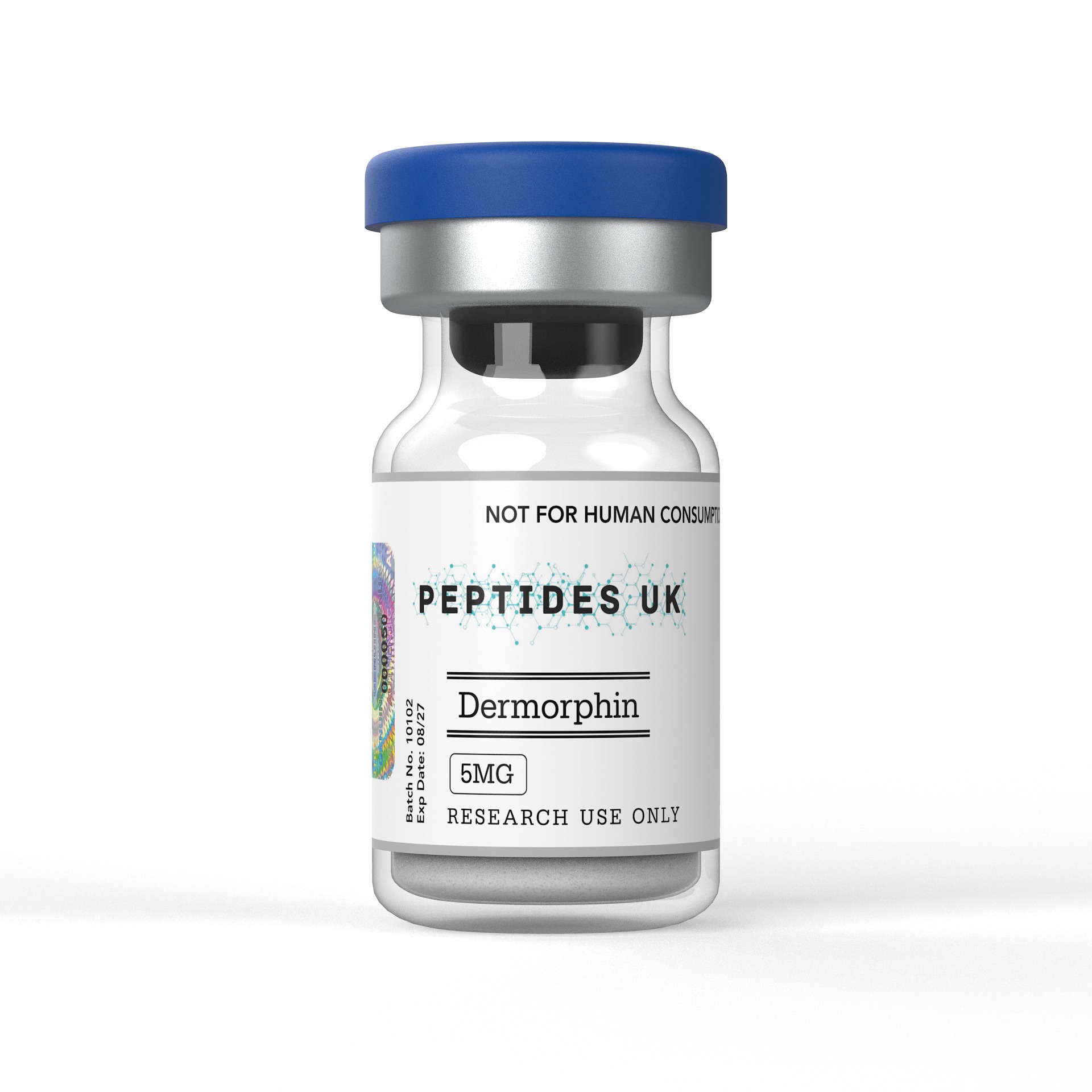
Dermorphin Peptide USA – Buy Online | In Stock & Ready to Ship
Buy Dermorphin in the USA with fast domestic shipping and guaranteed ≥99% purity — fully verified with COA and HPLC documentation. A trusted choice for USA research teams studying opioid receptor binding and pain pathway modulation, Dermorphin is available in multiple formats to suit varying project needs. No international delays — just reliable, domestically sourced peptides USA researchers can count on.
For research use only. Not intended for human or veterinary use.

Dermorphin is a naturally occurring heptapeptide isolated from the skin of South American Phyllomedusa frogs, studied for its exceptional selectivity and potency at mu-opioid receptors (MOR) — making it one of the most important reference peptides in opioid receptor pharmacology, pain pathway research, and analgesic drug discovery in the USA today.
Researchers, labs, and institutions across the United States can source verified, research-grade Dermorphin with fast dispatch, full documentation, and third-party verified purity.
✅ ≥99% Purity — HPLC & Mass Spectrometry Verified
✅ Batch-Specific Certificate of Analysis (CoA) Included
✅ Third-Party Tested | GMP Manufactured
✅ Fast Dispatch to USA — Tracked Shipping Available
Dermorphin is a seven-amino acid opioid peptide (Tyr-D-Ala-Phe-Gly-Tyr-Pro-Ser-NH₂) first isolated in 1981 from the skin secretions of the South American frog Phyllomedusa sauvagei by Italian researcher Vittorio Erspamer. It holds a significant place in peptide chemistry for two reasons: it is one of the most potent naturally occurring mu-opioid receptor (MOR) agonists ever identified, and it contains a D-alanine residue in its second position — making it one of the rare examples of a naturally occurring peptide that incorporates a D-amino acid in its native sequence.
The presence of D-alanine is not a trivial structural detail. Most endogenous mammalian peptides are composed entirely of L-amino acids and are rapidly degraded by peptidases. The D-amino acid in dermorphin confers significant resistance to enzymatic breakdown, contributing to its sustained biological activity and making it a structurally distinct research tool compared to endogenous opioid peptides like enkephalins and endorphins.
Dermorphin’s high mu-opioid receptor selectivity and its well-characterized binding profile have made it one of the most widely used reference ligands in opioid receptor research globally. It is supplied here as a research compound only and is not approved for human therapeutic use.
In research settings, dermorphin is studied primarily as a highly selective mu-opioid receptor (MOR) agonist and as a scaffold for developing novel opioid ligands. Studies have explored its role in:
Dermorphin is a research compound only and is not approved for human therapeutic use.
Dermorphin has been a subject of opioid receptor research since its discovery in 1981, with its research history spanning receptor pharmacology, structural peptide chemistry, pain biology, and — most recently — opioid use disorder biomarker development.
Mu-Opioid Receptor Binding and Selectivity Research
Equilibrium binding studies in rat brain membrane preparations revealed a single homogeneous population of high-affinity MOR binding sites, with a Kd of 0.46 nM and a binding maximum consistent with established mu-opioid receptor density. The rank order of potency observed across competitive binding assays with other mu-selective ligands confirmed dermorphin’s utility as a highly selective MOR reference compound. Receptor autoradiography studies using [³H]dermorphin produced a labeling pattern that paralleled those obtained with other established mu-opioid probes, confirming consistent MOR distribution mapping across brain structures.
Opioid Receptor Subtype Research
Research using naturally occurring dermorphin-like peptides from Phyllomedusa bicolor — alongside their carboxyl-terminal amide analogs — revealed a very high selectivity for mu opioid sites and provided evidence for the existence of two MOR subtypes of high and low affinity. This work, published in PNAS, contributed to a broader understanding of MOR heterogeneity and was instrumental in the pharmacological profiling of mu-receptor subpopulations.
Structure-Activity and Affinity Label Research
A series of dermorphin-based electrophilic affinity labels — incorporating bromoacetamide or isothiocyanate modifications — were developed and evaluated as covalent MOR probes, exhibiting IC₅₀ values in the range of 0.1–5 nM and wash-resistant inhibition of [³H]DAMGO binding at subnanomolar concentrations. These represent some of the highest-affinity peptide-based MOR affinity labels reported in the literature and are used as research tools for characterizing MOR binding site architecture.
Dermorphin-Derived Analogs and Analgesic Research
A substantial body of USA-based research has used dermorphin as a scaffold for developing novel analgesic candidates with modified receptor selectivity profiles. The dermorphin-derived tetrapeptide [Dmt¹]DALDA demonstrated subnanomolar mu receptor binding affinity, extraordinary mu receptor selectivity, and an antinociceptive effect approximately 3,000 times more potent than morphine in mouse tail-flick assays — with a duration of action approximately four times longer than morphine and no observed effect on respiration at tested doses. This class of research has informed the broader field of opioid peptide drug discovery aimed at separating analgesic efficacy from respiratory depression and dependence.
Peripheral MOR Activation and Neuropathic Pain Research
Preclinical research examining the dermorphin analog DALDA in a rat model of chemotherapy-induced neuropathic pain found that treatment significantly reduced both evoked and spontaneous pain behaviors without producing drug addiction or central side effects in the studied model. These findings support the value of peripherally selective dermorphin-based analogs as research tools for studying non-centrally mediated mu-opioid analgesia pathways.
Opioid Use Disorder Biomarker Research
Recent work has explored dermorphin-derived fluorescent conjugates as potential in vivo biomarker tools for studying MOR availability. A fluorescently labeled [Lys7]dermorphin conjugate demonstrated high-affinity MOR binding and rapid receptor internalization in vitro, with researchers proposing it as a candidate biomarker tool for studying mu-opioid receptor occupancy relevant to opioid use disorder pharmacotherapy research.
Bivalent and Multitarget Ligand Research
A bivalent ligand combining dermorphin with the NOP receptor peptide N/OFQ — designated DeNo — was characterized as a full agonist at both mu and NOP receptors, demonstrating antinociceptive activity via simultaneous activation of both receptor pathways in preclinical models. This work exemplifies how dermorphin’s well-defined MOR pharmacophore serves as a building block in multitarget opioid ligand design — an active area of analgesic drug discovery research.
All referenced findings are from pre-clinical or early-stage research. Dermorphin is not approved for human therapeutic use.
When you buy Dermorphin research peptide in the USA through our platform, every order includes:
We supply USA research peptides to licensed researchers, universities, and institutions — with cold-chain compliant packaging designed to maintain peptide integrity throughout transit.
| Parameter | Specification |
|---|---|
| Purity | ≥99% (HPLC & MS Verified) |
| Sequence | Tyr-D-Ala-Phe-Gly-Tyr-Pro-Ser-NH₂ |
| Amino Acids | 7 (heptapeptide) |
| Molecular Weight | 802.92 g/mol |
| Classification | Naturally occurring mu-opioid receptor agonist |
| Notable Feature | Contains D-alanine at position 2 (rare natural D-amino acid) |
| MOR Binding Affinity | Kd ~0.46 nM (rat brain membranes) |
| Solubility | Sterile water / 0.1% acetic acid |
| Storage (powder) | -20°C, stable 24+ months |
| Storage (reconstituted) | 2–8°C, use within 2–4 weeks |
| Available Sizes | 1mg |
Allow the vial to reach room temperature before opening. Add sterile water or 0.1% acetic acid slowly down the inside wall of the vial and swirl gently — do not shake. Prepare working solutions by diluting into appropriate assay buffer. For receptor binding assays, ensure pH compatibility with your assay conditions. Aliquot and store at -80°C for longer-term use. Avoid repeated freeze-thaw cycles.
| Feature | Dermorphin | DAMGO | Endomorphin-1 |
|---|---|---|---|
| Origin | Natural (frog skin) | Synthetic | Endogenous (mammalian) |
| Receptor Selectivity | MOR (highly selective) | MOR (selective) | MOR (highly selective) |
| D-Amino Acid | Yes (D-Ala, position 2) | Yes (D-Ala, position 2) | No |
| Binding Affinity (MOR) | Kd ~0.46 nM | Kd ~0.4 nM | Kd ~0.36 nM |
| Enzymatic Stability | High (D-amino acid) | High (D-amino acid) | Lower |
| Primary Research Use | MOR characterization / SAR scaffold | MOR reference ligand | Endogenous MOR ligand model |
| Analog Drug Discovery | Extensively studied (DALDA, DeNo) | Limited | Moderate |
Can I buy Dermorphin research peptide in the USA?
Yes. We supply research-grade Dermorphin with fast tracked dispatch across the United States for licensed laboratory research use. All orders include full purity documentation and integrity-maintained packaging.
What makes Dermorphin unique among opioid peptides?
Dermorphin is structurally distinguished by two properties rarely combined in naturally occurring peptides: its extremely high potency and selectivity at mu-opioid receptors, and its incorporation of a D-amino acid (D-alanine) in its native sequence. D-amino acids are virtually absent from endogenous mammalian peptides — their presence in dermorphin is thought to arise from a post-translational isomerization unique to amphibian skin peptide biosynthesis. This structural feature confers enzymatic stability that synthetic endogenous opioid peptides lack, making dermorphin a valuable and distinctive tool in receptor pharmacology research.
What is the difference between Dermorphin and DAMGO?
Both Dermorphin and DAMGO ([D-Ala², N-MePhe⁴, Gly-ol]-enkephalin) are highly selective mu-opioid receptor agonists widely used as MOR research tools. Dermorphin is a naturally occurring heptapeptide with a full C-terminal amide; DAMGO is a synthetic enkephalin analog. Both share a D-amino acid at position 2, contributing to their enzymatic stability. Dermorphin is primarily used as a natural MOR probe and medicinal chemistry scaffold; DAMGO is more commonly used in competitive binding assays and receptor internalization studies. For most MOR binding and autoradiography applications, the two are considered comparable reference ligands.
Is Dermorphin the same as a frog peptide?
Yes — dermorphin was first isolated from the skin secretions of Phyllomedusa sauvagei, a South American tree frog, in 1981. The compound used in research today is produced by synthetic peptide synthesis rather than biological extraction, ensuring consistent purity and reproducibility for laboratory applications.
What purity level should research-grade Dermorphin be?
≥98% is the accepted minimum for research-grade opioid peptides, though ≥99% is preferred for receptor binding, autoradiography, and structure-activity studies. All of our USA research peptides — including Dermorphin — are HPLC and mass spectrometry verified to ≥99%.
How quickly is Dermorphin delivered in the USA?
Orders are dispatched promptly with tracked shipping. Most USA orders arrive within 3–5 business days.
Where can I find Dermorphin peptide for sale in the USA?
We offer research-grade Dermorphin for sale in the USA exclusively for licensed laboratory research use, with full documentation and verified purity included as standard with every order.
Research Disclaimer: Dermorphin is supplied exclusively for legitimate scientific research purposes in licensed laboratory environments. This product is a potent mu-opioid receptor agonist and must be handled with appropriate care in accordance with institutional safety protocols. It is not intended for human consumption, self-administration, veterinary use, or therapeutic use of any kind. It must be handled by qualified researchers in strict accordance with all applicable US federal and state regulations, DEA guidelines, and institutional ethics and safety guidelines. By purchasing, you confirm that this compound will be used solely for approved in-vitro or pre-clinical research in a licensed facility.
Note: Dermorphin is prohibited for use in equine and other competitive animal sports by the Association of Racing Commissioners International (ARCI) and all major US racing jurisdictions. This product is not supplied for any veterinary, sporting, or non-research purpose.
Receive News