PRODUCTS SOLD ON PEPTIDESLABUSA.COM ARE FOR RESEARCH PURPOSES ONLY AND ARE NOT FOR HUMAN OR VETERINARY USE.
$92.50
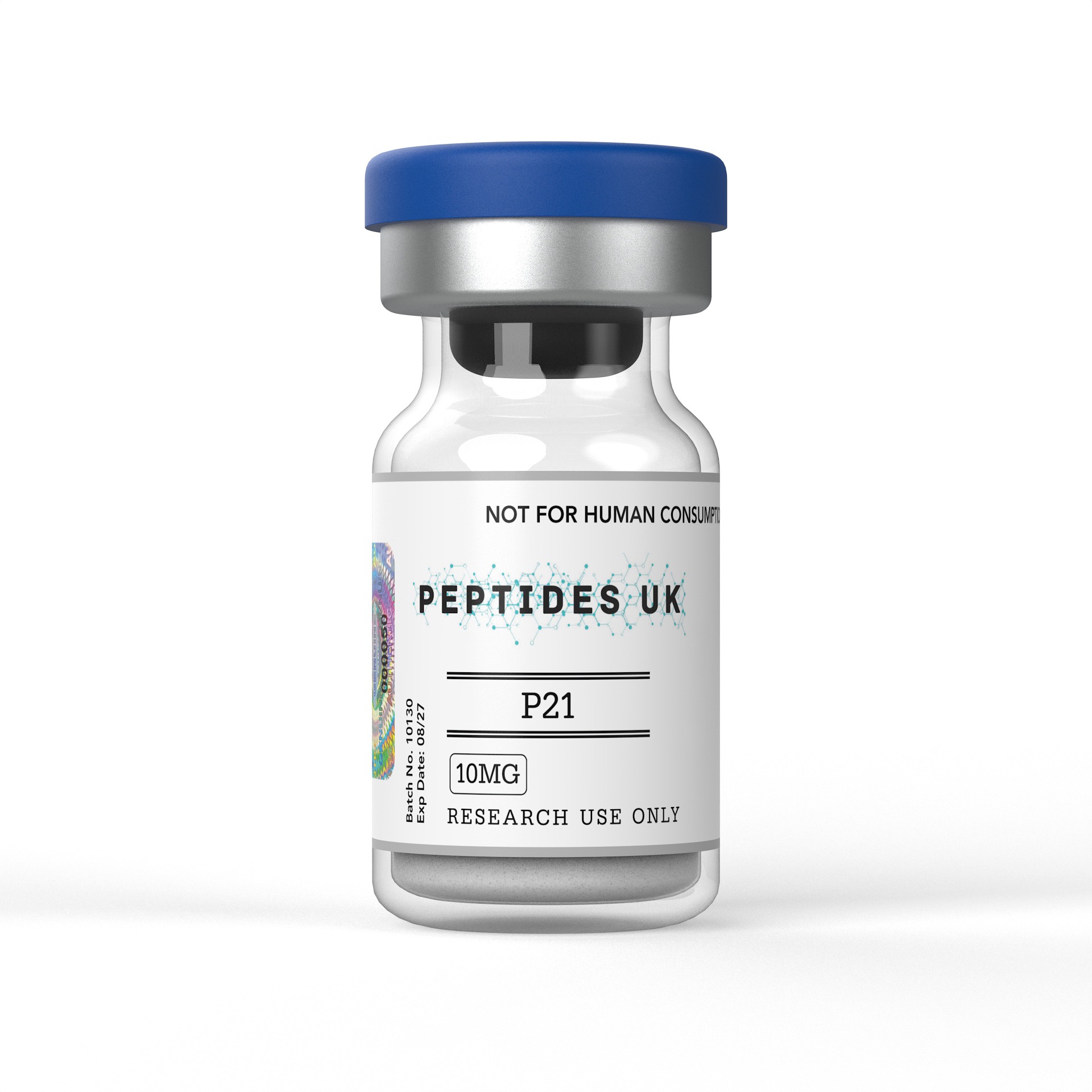
P21 Peptide USA – Buy Online | In Stock & Ready to Ship
Buy P21 peptide in the USA with fast domestic shipping and guaranteed ≥99% purity — fully verified with COA and HPLC documentation. A trusted choice for USA research teams studying cognitive function, neurogenesis and BDNF pathway activation, P21 is available in multiple formats to suit varying project needs. No international delays — just reliable, domestically sourced peptides USA researchers can count on.
For research use only. Not intended for human or veterinary use.


P21 — also known as P021 or Peptide 021 — is a synthetic tetrapeptide mimetic of ciliary neurotrophic factor (CNTF) engineered for blood-brain barrier permeability, studied for its role in neurogenesis, BDNF upregulation, tau pathology reduction, and cognitive function in preclinical research — making it one of the most closely followed nootropic research peptides available in the USA today.
Researchers, labs, and institutions across the United States can source verified, research-grade P21 peptide with fast dispatch, full documentation, and third-party verified purity.
✅ ≥99% Purity — HPLC & Mass Spectrometry Verified
✅ Batch-Specific Certificate of Analysis (CoA) Included
✅ Third-Party Tested | GMP Manufactured
✅ Fast Dispatch to USA — Tracked Shipping Available
P21 (also designated P021 or Peptide 021 in scientific literature) is a synthetic tetrapeptide derived from the most active region of ciliary neurotrophic factor (CNTF) — specifically amino acid residues 148–151 (Asp-Gly-Gly-Leu). It was developed through epitope mapping by Dr. Khalid Iqbal and colleagues at the New York State Institute for Basic Research in Developmental Disabilities, with the goal of creating a small, stable, CNS-accessible research tool capable of interrogating CNTF-associated neurogenic signaling pathways.
The defining structural feature of P21 is the addition of an adamantylated glycine (adamantane group) at its C-terminus. This modification — known as adamantylation — serves two critical purposes: it dramatically increases the compound’s resistance to enzymatic degradation, and it enhances lipophilicity to support blood-brain barrier (BBB) penetration. The result is a compact, stable, CNS-active research compound with a molecular weight of just 578.3 g/mol — far smaller and more experimentally tractable than the full 200-amino acid CNTF protein from which it was derived.
Full-length CNTF, while neurobiologically active, has significant limitations as a research compound: its size prevents it from crossing the blood-brain barrier, its plasma half-life is short, and systemic administration can provoke CNTF antibody formation. P21 was specifically designed to overcome all three of these limitations, making it a more practical and reproducible tool for studying CNTF-pathway neurogenesis in laboratory settings.
P21 is a research compound only and has not undergone human clinical trials.
In research settings, P21 is studied primarily as a neurogenic and neurotrophic compound that modulates CNTF-associated signaling through the inhibition of the leukemia inhibitory factor (LIF) pathway. Studies have explored its potential influence on:
P21 is a research compound only and has not undergone human clinical trials.
P21’s research literature spans approximately 10–15 peer-reviewed publications from 2010 to present, primarily from Dr. Iqbal’s group at the New York State Institute for Basic Research, with additional preclinical characterization work from institutions across the USA and internationally.
Alzheimer’s Disease Model Research
The most cited P21 research examines its effects in the 3xTg-AD mouse model — a triple transgenic model that develops both amyloid plaques and tau pathology alongside cognitive decline. Studies found that early intervention with P21 prevented cognitive impairment, reduced amyloid-beta accumulation, attenuated tau hyperphosphorylation, and rescued neurogenesis and synaptic deficits compared to untreated controls. Researchers concluded that P21 treatment during the synaptic compensation phase of disease progression was successful in preventing the transition to overt cognitive impairment — providing proof-of-principle for CNTF-pathway intervention as a potential disease-modifying research approach in AD models.
Neurogenesis and Dentate Gyrus Research
Foundational studies demonstrated that P21 enhances cellular proliferation and differentiation markers within the dentate gyrus of the hippocampal formation in both normal and cognitively impaired rodent models. BDNF expression was consistently elevated in treated animals, alongside markers of new neuron maturation and integration. Crucially, P21 did not produce the undifferentiated neuronal overproduction (“ectopic birth”) observed with earlier CNTF peptide candidates — a key refinement achieved through the adamantylation modification.
Cognitive Function Research in Normal and Aging Models
Studies in non-transgenic rodents showed P21 improved performance on spatial learning and memory tasks, with improvements attributable to enhanced dentate gyrus neurogenesis and synaptic protein restoration. Age-related cognitive decline models demonstrated that P21 could partially rescue the neurogenesis deficit characteristic of aging brains — positioning it as a research tool for studying intervention in age-related cognitive deterioration as well as disease models.
Down Syndrome Model Research
Preclinical research examined P21 in a mouse model of Down syndrome (trisomy 16), where cognitive impairment and reduced neurogenesis are consistent features. P21 treatment was associated with improvements in both neurogenesis markers and cognitive task performance, extending the compound’s research relevance beyond Alzheimer’s disease models.
Traumatic Brain Injury Research
Research has explored P21 in TBI models, where its combination of BDNF-upregulating and neuroprotective properties was examined for effects on post-injury neurogenesis and functional recovery. Findings in these models supported P21’s utility as a research tool for studying neurogenic responses to acute brain injury.
Preclinical Safety Profile
Published studies including up to 12 months of continuous P21 administration in mice reported no organ toxicity, tumorigenic effects, or behavioral abnormalities. Critically, P21 did not reproduce the anorexia, hyperalgesia, and bodyweight loss that limited clinical development of the parent CNTF molecule — outcomes attributed to P21’s focused pathway activity versus the broad systemic effects of full-length CNTF. All safety data is from preclinical animal studies. No controlled human clinical trials have been conducted.
All referenced findings are from pre-clinical research. P21 has not undergone human clinical trials and is not approved for human therapeutic use.
When you buy P21 peptide in the USA through our platform, every order includes:
We supply USA research peptides to licensed researchers, universities, and institutions — with cold-chain compliant packaging designed to maintain peptide integrity throughout transit.
| Parameter | Specification |
|---|---|
| Purity | ≥99% (HPLC & MS Verified) |
| Also Known As | P021, Peptide 021, Peptide 6C |
| Core Sequence | Asp-Gly-Gly-Leu (CNTF residues 148–151) |
| Modification | Adamantylated glycine at C-terminus |
| Molecular Formula | C₃₀H₅₄N₆O₅ |
| Molecular Weight | 578.3 g/mol |
| Classification | CNTF tetrapeptide mimetic / neurogenic compound |
| Form | White Lyophilized Powder |
| Solubility | Sterile water / DMSO |
| Storage (powder) | -20°C, stable 24+ months |
| Storage (reconstituted) | 2–8°C, use within 2–4 weeks |
| Available Sizes | 5mg |
Allow the vial to reach room temperature before opening. For aqueous reconstitution, add sterile water slowly down the inside wall of the vial and swirl gently — do not shake. If aqueous solubility is limited, prepare a stock solution in DMSO first and dilute into aqueous buffer to a final DMSO concentration below 0.1%. Aliquot and store at -80°C for longer-term stability. Avoid repeated freeze-thaw cycles.
| Feature | P21 (P021) | Semax | Cerebrolysin |
|---|---|---|---|
| Origin | CNTF tetrapeptide mimetic | ACTH fragment analog | Porcine brain peptide preparation |
| Primary Mechanism | LIF inhibition / BDNF upregulation | ACTH/melanocortin receptor pathway | Mixed neurotrophic factors (BDNF, GDNF, NGF, CNTF) |
| BBB Penetration | Yes (adamantane modification) | Yes | Limited (mixture dependent) |
| Tau / Amyloid Research | Extensively studied | Not primary focus | Limited |
| Neurogenesis Focus | Primary research area | Secondary | Moderate |
| Human Clinical Data | None (preclinical only) | Yes (clinical use in Russia) | Yes (clinical use in Europe/Asia) |
| Alzheimer’s Model Research | Extensively studied | Limited | Studied |
Can I buy P21 peptide in the USA?
Yes. We supply research-grade P21 (P021) with fast tracked dispatch across the United States. All orders include full purity documentation and integrity-maintained packaging for licensed laboratory research use.
What is the difference between P21 and P021?
P21 and P021 are the same compound — Peptide 021. The designation P021 is more commonly used in peer-reviewed scientific literature, while P21 is the more widely used shorthand in the USA research peptide community. Both refer to the same tetrapeptide: the adamantylated CNTF fragment with the core sequence Asp-Gly-Gly-Leu.
Is P21 derived from Cerebrolysin?
This is a common misconception in the USA nootropic research community. P21 is derived from CNTF (ciliary neurotrophic factor) through epitope mapping — not directly from Cerebrolysin. The connection is that CNTF is one of several neurotrophic components present in Cerebrolysin, which inspired researchers to investigate CNTF pathway signaling more closely. P21 is best understood as a synthetic, precisely defined analog of a specific active region of CNTF — not a Cerebrolysin derivative.
What is the adamantane modification in P21?
Adamantylation — the addition of an adamantane group to P21’s C-terminus — is a medicinal chemistry modification that increases the compound’s lipophilicity (fat-solubility) and resistance to enzymatic breakdown. Both properties are critical for a CNS-targeted research peptide: lipophilicity supports passive diffusion across the blood-brain barrier, and enzymatic stability extends the compound’s activity window in biological environments. Without this modification, the core tetrapeptide would be rapidly degraded and unlikely to reach brain tissue in meaningful concentrations.
Has P21 been tested in humans?
No. As of the time of publication, P21 has not undergone controlled human clinical trials. All published research is from preclinical animal studies — primarily rodent models. P21 is supplied here as a research compound only for use in licensed laboratory environments.
What purity level should research-grade P21 be?
≥98% is the accepted minimum for research-grade nootropic peptides, though ≥99% is preferred for neurogenesis, BDNF expression, and receptor pathway assays. All of our USA research peptides — including P21 — are HPLC and mass spectrometry verified to ≥99%.
How quickly is P21 delivered in the USA?
Orders are dispatched promptly with tracked shipping. Most USA orders arrive within 3–5 business days.
Where can I find P21 peptide for sale in the USA?
We offer research-grade P21 (P021) for sale in the USA exclusively for licensed research use, with full documentation and verified purity included as standard with every order.
Research Disclaimer: P21 (P021) is supplied exclusively for legitimate scientific research purposes in licensed laboratory environments. This product has not undergone human clinical trials and is not approved for human consumption, self-administration, or therapeutic use of any kind. It must be handled by qualified researchers in accordance with all applicable US federal and state regulations and institutional ethics guidelines. By purchasing, you confirm that this compound will be used solely for approved in-vitro or pre-clinical research.
Receive News