PRODUCTS SOLD ON PEPTIDESLABUSA.COM ARE FOR RESEARCH PURPOSES ONLY AND ARE NOT FOR HUMAN OR VETERINARY USE.
$56.50
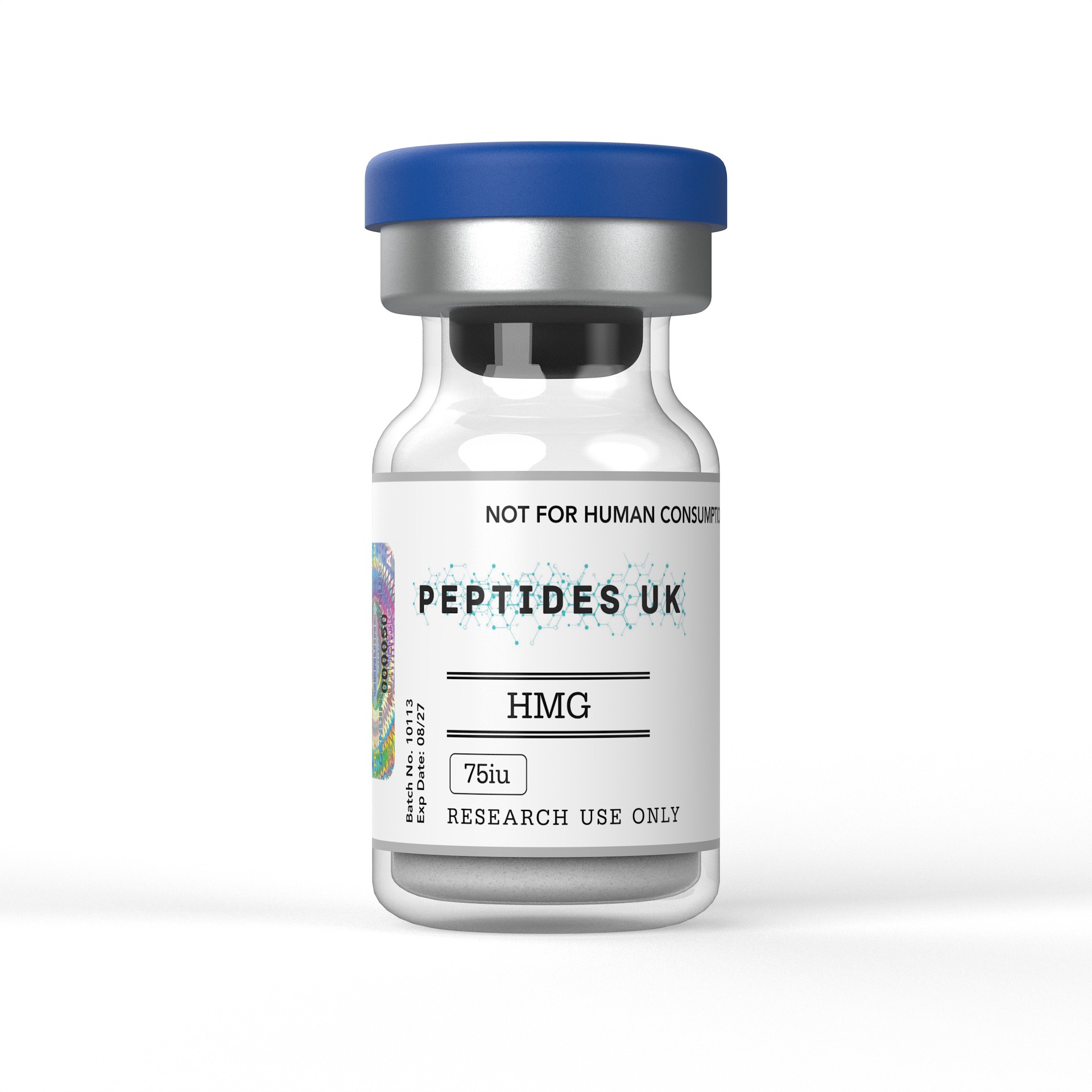
HMG USA – Buy Online | In Stock & Ready to Ship
Buy HMG in the USA with fast domestic shipping and guaranteed ≥99% purity — fully verified with COA and HPLC documentation. A trusted choice for USA research teams studying gonadotropin activity, follicular development and reproductive hormone pathways, HMG is available in multiple formats to suit varying project needs. No international delays — just reliable, domestically sourced peptides USA researchers can count on.
For research use only. Not intended for human or veterinary use.

Human Menopausal Gonadotropin (HMG) is a naturally derived gonadotropin preparation containing both FSH (follicle-stimulating hormone) and LH (luteinizing hormone) activity — studied extensively in reproductive endocrinology research for its role in gonadal stimulation, follicular development, and gonadotropin signaling pathways, making it one of the most established compounds in reproductive biology research available in the USA today.
Researchers, labs, and institutions across the United States can source verified, research-grade HMG with fast dispatch, full documentation, and third-party verified purity.
✅ ≥98% Purity — HPLC Verified
✅ Batch-Specific Certificate of Analysis (CoA) Included
✅ Endotoxin Tested | GMP Manufactured
✅ Fast Dispatch to USA — Tracked Shipping Available
Human Menopausal Gonadotropin — also known as menotropin or hMG — is a naturally derived gonadotropin preparation extracted and purified from the urine of postmenopausal women. Postmenopausal urine contains elevated concentrations of both follicle-stimulating hormone (FSH) and luteinizing hormone (LH) due to the loss of gonadal negative feedback in the menopausal state. HMG preparations standardly contain approximately 75 IU of FSH activity and 75 IU of LH activity per ampoule, along with trace amounts of human chorionic gonadotropin (hCG).
HMG was first developed as a research and clinical tool in 1949 by Piero Donini, who identified a practical method for extracting gonadotropins from postmenopausal urine. It was successfully introduced into clinical research and fertility treatment by Bruno Lunenfeld in 1961 — making HMG one of the earliest gonadotropin preparations to be systematically studied and one of the most historically significant compounds in reproductive endocrinology research.
The gonadotropin components of HMG — FSH and LH — are heterodimeric glycoprotein hormones, each composed of an alpha chain (shared between both hormones) and a unique beta chain that confers receptor specificity. FSH acts primarily on granulosa cells of ovarian follicles to stimulate follicular growth, estrogen synthesis via aromatase activity, and FSH receptor upregulation. LH acts on theca cells to drive androgen (testosterone) production that serves as the substrate for FSH-dependent estrogen synthesis — a division of function described in the well-established two-cell, two-gonadotropin theory of follicular development.
Research-grade HMG is supplied here for licensed laboratory and reproductive biology research purposes only.
In research settings, HMG is studied as a dual-activity gonadotropin preparation that simultaneously stimulates FSH and LH receptor pathways in gonadal tissue. Studies have explored its role in:
HMG is a research compound only and is not supplied here as a fertility treatment or therapeutic agent.
HMG has one of the longest and most extensively published research histories of any reproductive biology compound — spanning basic endocrinology, assisted reproductive technology (ART) outcomes research, and personalized medicine approaches to gonadotropin protocol design.
The Two-Cell, Two-Gonadotropin Theory — Foundational Research The physiological framework underlying HMG research is the two-cell, two-gonadotropin theory, which establishes that follicular estrogen synthesis requires both LH (acting on theca cells to produce androgens) and FSH (acting on granulosa cells to aromatize those androgens into estrogens). This theory — supported by decades of basic reproductive endocrinology research — provides the scientific rationale for studying dual-gonadotropin preparations like HMG alongside FSH-only recombinant preparations. Research consistently shows that HMG administration produces higher peak serum estradiol, androstenedione, and testosterone concentrations compared to FSH-only protocols — findings attributed to the LH component’s direct theca cell activity.
HMG vs Recombinant FSH — Meta-Analysis Evidence The relative merits of HMG versus recombinant FSH (rFSH) for ovarian stimulation have been examined in five major meta-analyses and numerous randomized controlled trials. The overall body of evidence shows that in GnRH agonist long-protocol cycles, FSH and HMG are equally effective in achieving ovarian stimulation with no significant differences in clinical pregnancy rates per cycle. However, in protocols without pituitary desensitization, FSH-only preparations showed greater efficacy in some analyses — underscoring that HMG’s research value is context-dependent and protocol-specific. One pivotal randomized trial found a significantly higher fertilization rate in HMG-treated groups (56% vs 50%) and fewer cycle cancellations due to complete fertilization failure compared to highly purified FSH — suggesting that LH bioactivity contributes positively to fertilization competence in certain research models.
LH Supplementation and Subgroup Research One of the most active areas of HMG research examines which patient or experimental populations derive the most benefit from LH supplementation via HMG. Mounting evidence from clinical research identifies three subgroups as most likely to benefit from HMG over FSH alone: women with low endogenous LH levels, older research populations, and those prone to hyper-response during controlled ovarian stimulation. A PMC-indexed study examining HMG supplementation in patients with mid-follicular serum LH concentrations of 0.5–1.5 IU/L found no significant improvement in pregnancy rates with HMG addition, suggesting that exogenous LH supplementation via HMG may not be warranted when endogenous LH is within this range — supporting a personalized, LH-threshold-based approach to gonadotropin research protocol design.
Oocyte Quality and Follicular Biology Research Studies have consistently noted that despite producing fewer total follicles than FSH-only protocols in some models, HMG stimulation is associated with higher numbers of matured metaphase-II oocytes — particularly when LH bioactivity is sourced from hCG rather than pituitary LH. This finding aligns with research showing that LH may induce atresia of smaller, less competent follicles while supporting the final maturation of larger, more reproductively competent follicles — a selective follicular effect of particular interest in oocyte quality research.
Male Reproductive Biology Research HMG is studied in male reproductive endocrinology for its dual FSH/LH activity on testicular function. FSH acts on Sertoli cells to support spermatogenesis and spermatid maturation; LH acts on Leydig cells to stimulate testosterone production. Research examining HMG in hypogonadotropic hypogonadism models — where both FSH and LH pituitary signals are absent — has established HMG as a foundational research tool for studying gonadotropin-dependent spermatogenesis restoration and testicular steroidogenesis.
Highly Purified HMG (HP-hMG) Research Modern HMG preparations are produced as highly purified forms (HP-hMG) with greater than 98% gonadotropin purity — a significant advance over earlier preparations that contained substantial non-gonadotropin urinary proteins associated with local reactions and batch inconsistency. Research comparing HP-hMG with earlier standard HMG preparations and with recombinant gonadotropins has generally confirmed equivalent or slightly superior clinical outcomes for HP-hMG in IVF research models, while the highly purified profile improves batch-to-batch consistency relevant to research reproducibility.
All referenced findings are from pre-clinical studies or clinical research. Research-grade HMG is supplied here for licensed laboratory use only and is not provided as a fertility treatment or therapeutic agent.
When you buy research-grade HMG in the USA through our platform, every order includes:
We supply USA research compounds to licensed researchers, universities, and institutions — with cold-chain compliant packaging designed to maintain gonadotropin integrity throughout transit.
| Parameter | Specification |
|---|---|
| Purity | ≥98% (HPLC Verified) |
| Also Known As | hMG, Menotropin, Human Menopausal Gonadotropin |
| FSH Activity | ~75 IU per ampoule |
| LH Activity | ~75 IU per ampoule |
| Additional Components | Trace hCG; excipients |
| Source | Purified postmenopausal urine extract |
| Form | Lyophilized Powder |
| Solubility | Sterile water for injection / PBS |
| Storage (powder) | 2–8°C or -20°C; protect from light |
| Storage (reconstituted) | 2–8°C; use promptly |
| Available Sizes | 75 IU |
Allow the vial to reach room temperature before opening. Add sterile water or PBS slowly to the vial and swirl gently — do not shake. Reconstitute immediately before use where possible. Reconstituted solutions should be kept at 2–8°C and used within the same research session or within 24 hours. Do not freeze reconstituted HMG — freezing can denature the glycoprotein structure. Always follow your batch-specific CoA for confirmed handling conditions.
| Feature | HMG | Recombinant FSH (rFSH) | Recombinant LH (rLH) |
|---|---|---|---|
| FSH Activity | Yes (~75 IU) | Yes (pure FSH) | No |
| LH Activity | Yes (~75 IU, via hCG) | No | Yes (pure LH) |
| Origin | Urinary (postmenopausal women) | Recombinant (CHO cells) | Recombinant (CHO cells) |
| Batch Consistency | Good (HP-hMG) | Excellent | Excellent |
| Two-Cell Pathway Coverage | Complete (FSH + LH) | Partial (FSH only) | Partial (LH only) |
| Primary Research Use | Dual gonadotropin stimulation | FSH-specific pathway research | LH-specific pathway research |
| Historical Research Base | Extensive (since 1961) | Extensive (since 1990s) | Moderate |
Can I buy HMG research compound in the USA? Yes. We supply research-grade Human Menopausal Gonadotropin (HMG / menotropin) with fast tracked dispatch across the United States for licensed laboratory research use. All orders include full documentation and integrity-maintained packaging.
What is the difference between HMG and recombinant FSH? HMG contains both FSH and LH activity — reflecting the two-cell, two-gonadotropin requirement for complete follicular steroidogenesis. Recombinant FSH contains only FSH activity with no LH component. In research terms, HMG is used when studying dual gonadotropin signaling pathways, LH supplementation effects, or the LH contribution to oocyte quality and theca cell androgen production. Recombinant FSH is used when isolating FSH-specific pathway effects without LH variable confounding.
What is the two-cell, two-gonadotropin theory? The two-cell, two-gonadotropin theory is the foundational framework for understanding how follicular estrogen is produced. LH binds to receptors on theca cells, stimulating the production of androgens (primarily testosterone). FSH binds to receptors on granulosa cells, activating aromatase — the enzyme that converts theca-derived androgens into estrogens. Both cell types and both gonadotropins are required for normal estrogen synthesis. HMG provides both hormones simultaneously, making it the research tool of choice for studying this complete dual-cell pathway.
Is HMG the same as Menopur or Pergonal? Menopur, Pergonal, Repronex, and Humegon are all brand names of pharmaceutical HMG preparations approved for therapeutic use in fertility clinics. Research-grade HMG is the same compound class — containing standardized FSH and LH activity from postmenopausal urinary extraction — but is supplied here for licensed laboratory research purposes only, not as a fertility treatment or therapeutic agent.
What is the difference between HMG and hCG? HMG contains both FSH and LH activity and is used for follicular stimulation throughout the growth phase of the cycle. hCG (human chorionic gonadotropin) is structurally similar to LH and is typically used as a trigger injection to initiate final oocyte maturation and ovulation — administered after follicles have been adequately developed using gonadotropin preparations like HMG or FSH.
What purity standard applies to research-grade HMG? Research-grade HMG is assessed by gonadotropin activity (IU) per ampoule and overall protein purity by HPLC. Highly purified HMG (HP-hMG) preparations achieve ≥98% gonadotropin purity — a significant improvement over older standard preparations. Our HMG meets HP-hMG purity standards with full endotoxin and sterility verification included with every order.
How quickly is HMG delivered in the USA? Orders are dispatched promptly with cold-chain compliant tracked shipping. Most USA orders arrive within 3–5 business days.
Where can I find HMG research compound for sale in the USA? We offer research-grade HMG (menotropin) for sale in the USA exclusively for licensed laboratory research use, with full documentation and verified gonadotropin activity included as standard with every order.
Research Disclaimer: Human Menopausal Gonadotropin (HMG / menotropin) is supplied exclusively for legitimate scientific research purposes in licensed laboratory environments. This product is not intended for human self-administration, unsupervised fertility treatment, or any therapeutic use outside of licensed clinical or research settings. It must be handled by qualified researchers in accordance with all applicable US federal and state regulations and institutional ethics guidelines. By purchasing, you confirm that this compound will be used solely for approved in-vitro or pre-clinical research.
Receive News