Here’s the full USA-optimized product description — just copy and paste directly into your website:
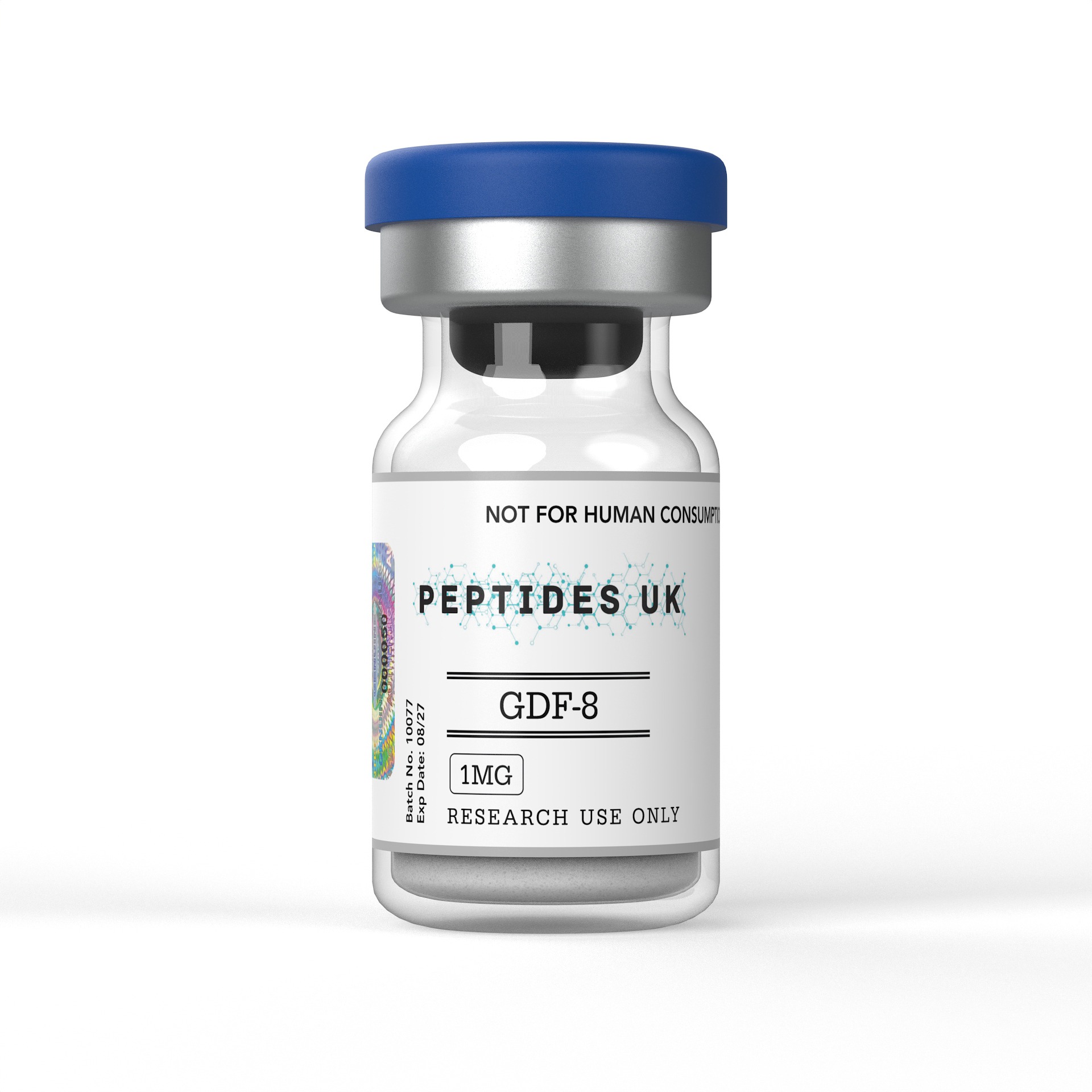
GDF-8 Research-Grade Peptide | Buy GDF-8 in USA | ≥99% Purity
GDF-8 (Myostatin) is a research-grade TGF-β superfamily protein used in laboratory studies to investigate skeletal muscle growth regulation, muscle wasting pathways, and SMAD2/3 signaling — available to buy in the USA with fast domestic dispatch and batch-specific Certificates of Analysis.
✅ ≥99% Purity — HPLC & Mass Spectrometry Verified
✅ Batch-Specific Certificate of Analysis (CoA) Included
✅ Sterile Lyophilized Powder | GMP Manufactured
✅ Fast USA Dispatch | Ships to All 50 States
✅ Research Use Only
What is GDF-8 (Myostatin)?
GDF-8, commonly known as Myostatin, is a naturally occurring protein that acts as the body’s built-in brake on skeletal muscle growth. It belongs to the TGF-β (Transforming Growth Factor-beta) superfamily — a group of signaling proteins that regulate how cells grow, differentiate, and respond to their environment.
Produced primarily in skeletal muscle, Myostatin works in a self-regulating loop: as muscle grows, Myostatin signals the body to slow that growth down. It does this by binding to a receptor called ActRIIB on muscle cell surfaces, triggering a signaling chain (through SMAD2/3) that suppresses both muscle stem cell activity and the body’s main anabolic growth pathway (IGF-1/Akt/mTOR).
In research settings, GDF-8 is used as a reference protein for studies examining how this inhibitory pathway works, how it can be disrupted, and what happens at the molecular level when Myostatin signaling is altered — making it a cornerstone reagent in muscle biology laboratories across the USA.
What Does GDF-8 (Myostatin) Do in Research?
In the laboratory, GDF-8 is used across a wide range of muscle biology and TGF-β signaling studies. Key research applications include:
- Studying how Myostatin binds to ActRIIB receptors and initiates inhibitory signaling
- Examining SMAD2/3 pathway activation and downstream gene transcription changes
- Investigating satellite cell (muscle stem cell) suppression and activation dynamics
- Screening Myostatin inhibitors, neutralizing antibodies, and receptor antagonists
- Researching muscle atrophy and cachexia signaling pathways
- Exploring the Myostatin-Follistatin regulatory axis
- Studying sarcopenia and age-related muscle loss mechanisms
- Examining cross-talk between Myostatin and IGF-1/Akt/mTOR anabolic pathways
- Cardiac muscle biology and fibrosis pathway research
What Do Studies Say About GDF-8?
Knockout research: The original GDF-8 knockout mouse studies produced one of the most striking phenotypes in muscle biology — animals lacking Myostatin developed roughly twice the skeletal muscle mass of normal mice, through both increased fiber number and increased fiber size. These foundational studies established GDF-8 as the primary endogenous constraint on skeletal muscle mass.
Natural mutations: Natural Myostatin loss-of-function mutations have been identified across multiple species — Belgian Blue and Piedmontese cattle, Texel sheep, whippet dogs, and rare human cases — all showing dramatically increased muscle mass. These real-world genetic examples provide cross-species confirmation of Myostatin’s conserved role in muscle regulation.
Signaling mechanism: Research has mapped Myostatin’s full molecular cascade — from ActRIIB binding through SMAD2/3 activation to suppression of MyoD, myogenin, and downstream anabolic genes — providing the mechanistic foundation for drug target research in muscle wasting conditions.
Atrophy and cachexia: Studies have documented elevated Myostatin expression in models of cancer cachexia, disuse atrophy, glucocorticoid-induced muscle loss, and age-related sarcopenia — establishing GDF-8 signaling as a key pathway in pathological muscle wasting.
Follistatin interaction: The Follistatin-Myostatin axis is one of the most studied regulatory systems in muscle mass homeostasis. Follistatin acts as a natural high-affinity Myostatin binding protein — research overexpressing Follistatin has produced muscle hypertrophy that mirrors Myostatin knockout phenotypes, highlighting this balance as a key ongoing research area.
GDF-8 vs Related Research Proteins
| Compound |
Type |
Effect on Muscle |
Primary Research Focus |
| GDF-8 (Myostatin) |
TGF-β superfamily |
Negative — inhibits growth |
Muscle mass regulation, atrophy |
| GDF-11 |
TGF-β superfamily |
Negative regulator |
Aging biology, muscle research |
| Follistatin |
Endogenous antagonist |
Positive — blocks Myostatin |
Myostatin inhibition studies |
| Activin A |
TGF-β superfamily |
Negative regulator |
Muscle wasting, cachexia |
| IGF-1 |
Growth factor |
Positive — promotes growth |
Anabolic signaling, muscle growth |
GDF-8 Product Specifications
| Parameter |
Detail |
| Also Known As |
Myostatin, GDF-8 |
| Type |
TGF-β Superfamily Growth Factor |
| Primary Receptor |
Activin Receptor Type IIB (ActRIIB) |
| Purity |
≥99% |
| Verification |
HPLC & Mass Spectrometry |
| Form |
Lyophilized Powder |
| Storage |
-20°C, protected from light and moisture |
| Intended Use |
Research use only |
Buying GDF-8 in the USA — What’s Included
Every order shipped within the USA includes:
- Batch-specific Certificate of Analysis (CoA)
- HPLC Chromatogram
- Mass Spectrometry Confirmation
- Sterility & Endotoxin Testing Reports
- Reconstitution Protocol
- Technical Research Support
Frequently Asked Questions
Can I buy GDF-8 in the USA? Yes. We supply research-grade GDF-8 (Myostatin) with fast dispatch to all US states. All orders include full batch documentation and are packaged to maintain protein stability throughout transit. This product is supplied strictly for laboratory research use only.
What is the difference between GDF-8 and GDF-11? GDF-8 and GDF-11 share approximately 90% sequence homology and both signal through ActRIIB, but they have distinct roles. GDF-8 is the well-established primary muscle growth inhibitor expressed predominantly in skeletal muscle. GDF-11 has been studied more in the context of aging biology, though its role remains more contested in the research literature. Their structural similarity makes comparative pharmacology an important research area.
How does Myostatin inhibit muscle growth? Myostatin binds to ActRIIB on muscle cell surfaces, recruiting ALK4/ALK5 co-receptors and activating SMAD2/3 signaling. SMAD2/3 then suppresses key muscle growth transcription factors (MyoD and myogenin) and downregulates the IGF-1/Akt/mTOR anabolic pathway — effectively setting a ceiling on skeletal muscle development under normal physiological conditions.
How is GDF-8 reconstituted for lab use? Allow the vial to reach room temperature before opening. Add sterile water or appropriate laboratory buffer slowly along the vial wall and swirl gently — do not shake. Avoid reducing agents, as GDF-8 is a disulfide-bonded dimeric protein and reducing conditions will disrupt the native bonds required for biological activity. Aliquot promptly and store at -80°C to minimize freeze-thaw degradation.
How quickly does GDF-8 ship to USA addresses? Orders are dispatched promptly via tracked courier. Domestic USA delivery typically takes 2–4 business days, with packaging designed to maintain protein integrity throughout transit.
Research Disclaimer: GDF-8 (Myostatin) is supplied exclusively for legitimate scientific research conducted within licensed laboratory environments. This product is not intended for human consumption, self-administration, or any therapeutic or veterinary application. It must be handled solely by qualified researchers in compliance with applicable US federal and state regulations and institutional ethics guidelines. By purchasing, you confirm this compound will be used exclusively for approved in vitro or pre-clinical research purposes.