PRODUCTS SOLD ON PEPTIDESLABUSA.COM ARE FOR RESEARCH PURPOSES ONLY AND ARE NOT FOR HUMAN OR VETERINARY USE.
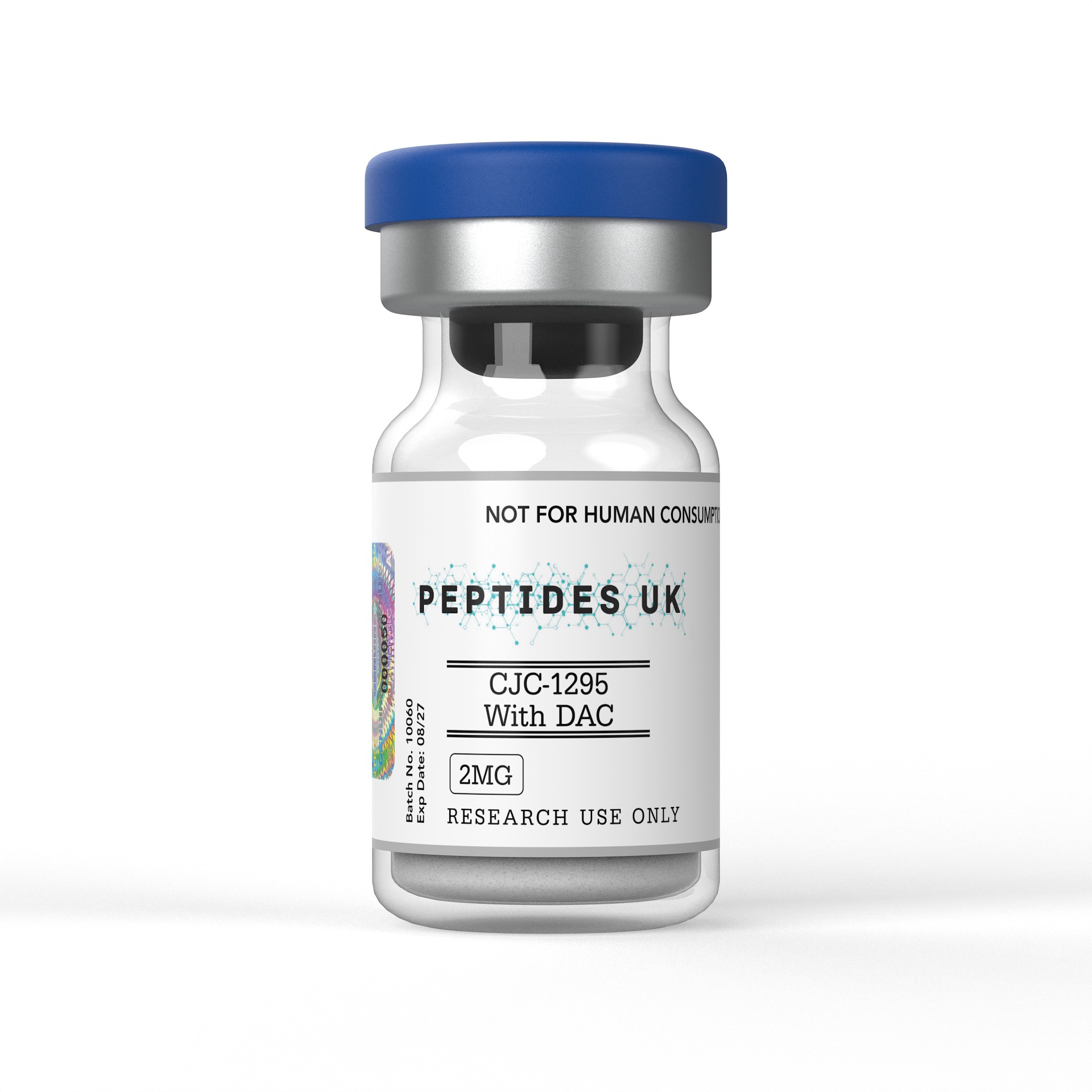
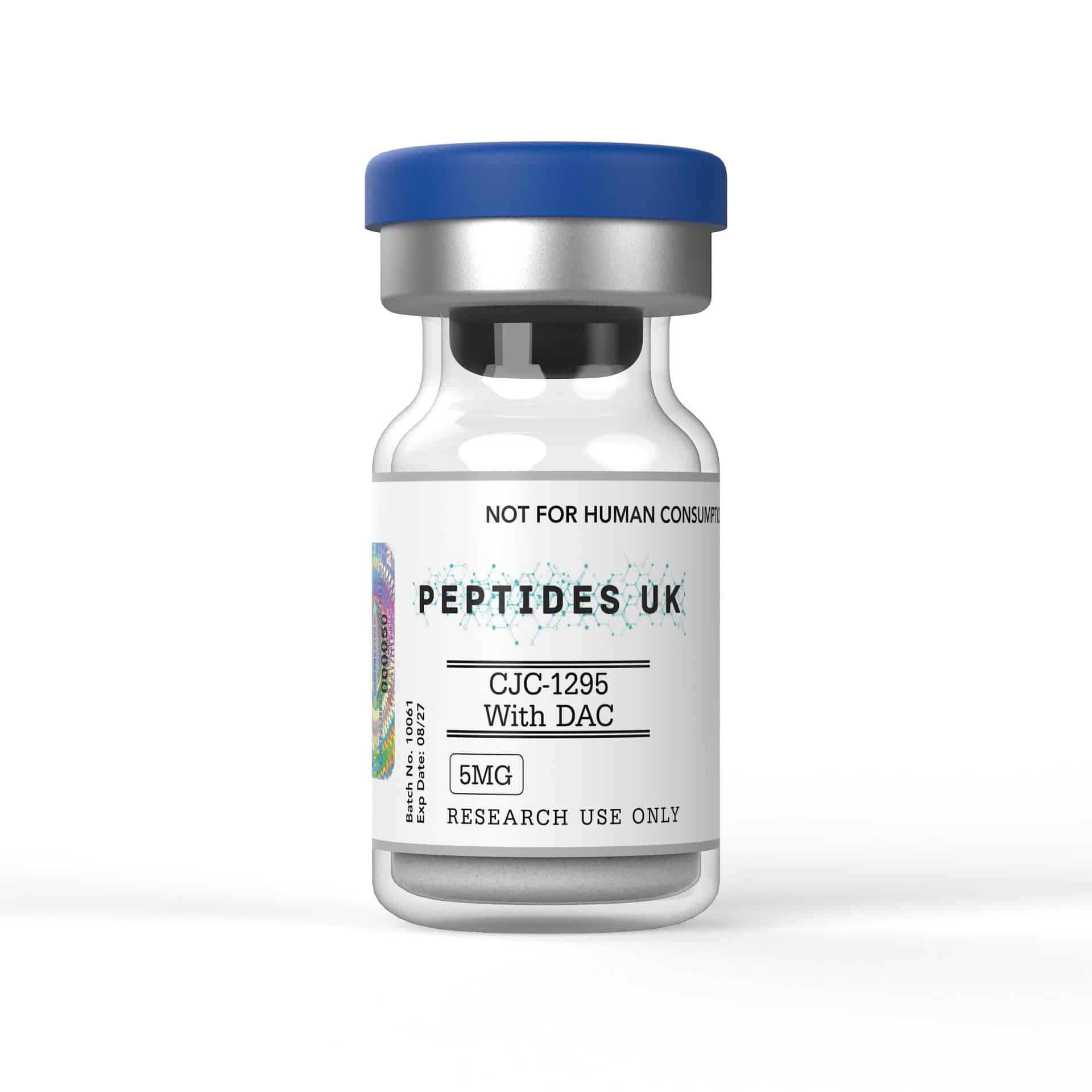
$80.50 – $132.50Price range: $80.50 through $132.50
CJC-1295 With DAC Peptide USA – Buy Online | In Stock & Ready to Ship
Buy CJC-1295 With DAC in the USA with fast domestic shipping and guaranteed ≥99% purity — fully verified with COA and HPLC documentation. A trusted choice for USA research teams studying long-acting growth hormone releasing hormone analogue activity, extended pituitary stimulation and sustained GH secretion pathways, CJC-1295 With DAC is available in multiple formats to suit varying project needs. No international delays — just reliable, domestically sourced peptides USA researchers can count on.
For research use only. Not intended for human or veterinary use.

CJC-1295 with DAC is a synthetic research peptide and long-acting GHRH analogue — engineered to bind covalently to circulating albumin after administration, extending its active half-life from minutes to approximately 6–8 days and enabling sustained, physiologically relevant growth hormone stimulation in pre-clinical research models.
Available for US researchers and institutions with fast domestic dispatch, full batch documentation, and verified ≥99% purity on every vial.
✅ ≥99% Purity — HPLC & Mass Spectrometry Verified
✅ Batch-Specific Certificate of Analysis (CoA) Included
✅ Sterile Lyophilised Powder | GMP Manufactured
✅ Fast Dispatch Across the USA | USA Peptides In Stock
CJC-1295 with DAC is a synthetic 30-amino acid analogue of growth hormone-releasing hormone (GHRH) — the hypothalamic peptide that stimulates the pituitary gland to produce and release growth hormone. It was developed by ConjuChem Biotechnologies as part of a programme to engineer GHRH analogues with dramatically extended biological half-lives suitable for less frequent dosing in research and potential therapeutic contexts.
The peptide is built on a modified GHRH(1-29) backbone — the biologically active N-terminal fragment of the 44-amino acid native GHRH — with four amino acid substitutions that improve proteolytic stability and receptor binding affinity. Appended to this backbone is the Drug Affinity Complex (DAC) — a maleimidoproprionic acid linker that reacts with the free thiol group of Cys34 on circulating albumin via a Michael addition reaction, forming a stable covalent bond. This albumin-binding chemistry is the defining feature of CJC-1295 with DAC and the mechanism responsible for its extended half-life.
Native GHRH has a plasma half-life of just a few minutes due to rapid cleavage by dipeptidyl peptidase IV (DPP-IV) and other proteases. CJC-1295 without DAC (also called Mod GRF 1-29) extends this to approximately 30 minutes through amino acid substitutions alone. CJC-1295 with DAC extends it further to approximately 6–8 days by tethering the peptide to long-lived albumin — making it one of the longest-acting synthetic GHRH analogues available as a research tool.
The molecular weight of CJC-1295 with DAC is approximately 3647.3 g/mol (CAS 863288-34-0). Its extended pharmacokinetic profile produces a sustained elevation of baseline GH and IGF-1 levels — in contrast to the sharp, short GH pulses produced by GHRP compounds — making it a complementary rather than competing tool in somatotropic axis research.
In laboratory and pre-clinical research settings, CJC-1295 with DAC has been studied across a range of endocrine, metabolic, and anabolic research areas:
Sustained GH and IGF-1 Elevation
The primary research application of CJC-1295 with DAC is the sustained elevation of baseline GH and IGF-1 levels over extended time periods — days rather than the minutes-long pulses produced by GHRP compounds or native GHRH. Pre-clinical and human studies documented that a single administration of CJC-1295 with DAC produces GH levels elevated above baseline for up to 6 days and IGF-1 elevation persisting for up to 9–11 days — enabling research into the biological consequences of prolonged somatotropic axis activation without the need for repeated daily dosing protocols.
Somatotropic Axis and GHRH Receptor Research
CJC-1295 with DAC acts exclusively through the GHRH receptor (GHRHR) on pituitary somatotroph cells — activating Gαs-adenylyl cyclase-cAMP-PKA signalling to stimulate GH gene transcription and GH secretory granule release. Its high receptor affinity relative to native GHRH — resulting from the amino acid substitutions in its modified backbone — makes it a valuable tool for GHRHR pharmacology research, receptor occupancy studies, and characterising the downstream transcriptional and secretory consequences of sustained versus pulsatile GHRHR activation.
IGF-1 Axis and Anabolic Biology Research
CJC-1295 with DAC-driven GH elevation produces sustained hepatic IGF-1 production via GH receptor-JAK2-STAT5 signalling — with the prolonged IGF-1 elevation enabling research into the time-dependent anabolic consequences of IGF-1/Akt/mTOR pathway activation, including protein synthesis, muscle hypertrophy, satellite cell biology, and anti-catabolic signalling in skeletal muscle. Human clinical studies confirmed statistically significant increases in IGF-1 levels in subjects receiving CJC-1295 with DAC — providing translational context for the pre-clinical anabolic biology data.
Pulsatile vs Sustained GH Release Research
One of the most research-relevant properties of CJC-1295 with DAC is the contrast between its sustained GH elevation profile and the pulsatile GH spikes produced by GHRPs. Research examining the biological consequences of pulsatile versus tonic GH signalling — including differential effects on IGF-1 production, hepatic GH receptor regulation, insulin sensitivity, body composition, and gene expression in GH-responsive tissues — can use CJC-1295 with DAC as the sustained GH tool alongside GHRP compounds as the pulsatile GH tool in comparative study designs.
Body Composition Research
Pre-clinical studies and early-phase human research documented measurable changes in body composition following CJC-1295 with DAC administration — including reductions in fat mass and increases in lean mass attributable to sustained GH/IGF-1 axis activation. These body composition findings are consistent with the known metabolic effects of GH — lipolysis stimulation, protein synthesis promotion, and anti-catabolic effects — and have positioned CJC-1295 with DAC as a relevant tool for studying the anabolic and lipolytic consequences of prolonged somatotropic axis activation in obesity, sarcopenia, and ageing research models.
Muscle and Sarcopenia Research
Sustained IGF-1 elevation driven by CJC-1295 with DAC provides prolonged activation of the IGF-1/Akt/mTOR anabolic pathway in skeletal muscle — relevant to research into muscle mass preservation, satellite cell activation, and resistance to age-related and disease-related muscle wasting. Studies have examined CJC-1295 with DAC in the context of sarcopenia models, with sustained GH/IGF-1 signalling providing a mechanistic rationale for lean mass preservation effects documented in pre-clinical body composition research.
Sleep and GH Secretion Research
GH secretion is physiologically linked to slow-wave sleep, with the largest endogenous GH pulse occurring shortly after sleep onset. Research has used GHRH analogues including CJC-1295 with DAC to probe the relationship between GHRHR activation, slow-wave sleep architecture, and nocturnal GH secretion patterns — with studies documenting that GHRH receptor stimulation can both amplify nocturnal GH pulses and modulate sleep architecture, establishing a bidirectional relationship between the somatotropic axis and sleep biology.
Combination Research With GHRP Compounds
CJC-1295 with DAC is frequently used in research alongside GHRP compounds — particularly GHRP-2, GHRP-6, and ipamorelin — to combine the complementary GHRHR (Gαs-cAMP) and GHS-R1a (Gαq/11-calcium) signalling pathways for synergistic GH output. This combination mirrors the physiological coordination of GHRH and ghrelin in endogenous GH pulse generation and produces GH responses exceeding what either compound achieves alone — making the CJC-1295 with DAC plus GHRP combination a well-established paradigm in somatotropic axis research.
All applications listed are for pre-clinical and laboratory research use only.
CJC-1295 with DAC has a clinical and pre-clinical research record spanning pharmacokinetics, somatotropic axis biology, and body composition:
On pharmacokinetics and GH elevation: Human phase I/II clinical studies confirmed that CJC-1295 with DAC produces dose-dependent GH elevation with a mean half-life of approximately 6–8 days — consistent with albumin-binding-mediated protection from proteolytic clearance. A single injection produced GH levels elevated above baseline for up to 6 days and IGF-1 elevation persisting for up to 9–11 days across the dose range studied. These were the first clinical data confirming the DAC albumin-binding chemistry translated the extended half-life observed pre-clinically into the human pharmacokinetic setting.
On IGF-1: The same clinical studies documented mean IGF-1 increases of 30–40% above baseline following CJC-1295 with DAC administration — with elevations sustained across the multi-day observation window and dose-response relationships consistent across study participants, confirming reliable and sustained somatotropic axis activation.
On body composition: Pre-clinical studies documented reductions in fat mass and increases in lean mass in animal models receiving CJC-1295 with DAC — consistent with sustained GH/IGF-1 axis activation and the known lipolytic and anabolic consequences of prolonged GH elevation, establishing a mechanistic basis for the body composition changes observed in early human research.
On safety and tolerability: Phase I/II human studies reported a favourable tolerability profile for CJC-1295 with DAC across the doses studied, with the most commonly noted observations being mild injection site reactions and transient flushing — consistent with the vasodilatory properties of GHRH receptor activation. No serious adverse events were attributed to the peptide in the published clinical data.
| CJC-1295 With DAC | CJC-1295 Without DAC (Mod GRF 1-29) | Sermorelin | GHRP-2 / GHRP-6 | |
|---|---|---|---|---|
| Mechanism | GHRH analogue — albumin-binding DAC for extended half-life | GHRH analogue — stabilised backbone, no albumin binding | GHRH(1-29) analogue — minimal modifications | GHS-R1a agonists — distinct non-GHRH pathway |
| Half-Life | ~6–8 days — albumin-bound | ~30 minutes | ~10–20 minutes | ~20–30 minutes |
| GH Release Profile | Sustained baseline elevation over days | Short pulsatile spike — mirrors natural GHRH | Short pulsatile spike | Short pulsatile spike |
| IGF-1 Elevation | Sustained — days-long elevation documented in human studies | Transient — returns to baseline with GH pulse | Transient | Transient — GH-dependent |
| Dosing Frequency | Once weekly suitable in research protocols | Daily or multiple times daily | Daily | Daily or multiple times daily |
| Best For | Sustained GH/IGF-1 axis activation / long-duration anabolic research / pulsatile vs tonic GH comparison studies | Physiological GH pulse simulation / combination with GHRPs | GHRH receptor pharmacology / GH secretion research | Pulsatile GH spikes / GHS-R1a pharmacology / GHRP-specific biology |
| Parameter | Detail |
|---|---|
| Full Name | CJC-1295 with DAC (Drug Affinity Complex) |
| Alternative Names | CJC-1295 DAC; DAC:GRF |
| CAS Number | 863288-34-0 |
| Molecular Weight | ~3647.3 g/mol |
| Peptide Length | 30 amino acids (modified GHRH 1-29 backbone + DAC linker) |
| Backbone | Modified GHRH(1-29) — four amino acid substitutions for DPP-IV resistance and GHRHR affinity |
| DAC Technology | Maleimidoproprionic acid linker — covalent albumin binding via Cys34 thiol Michael addition |
| Primary Receptor | GHRHR (growth hormone-releasing hormone receptor) — Gαs/cAMP/PKA pathway |
| Half-Life | ~6–8 days (albumin-bound) |
| GH Release Profile | Sustained baseline elevation — days-long |
| IGF-1 Elevation | Sustained — 30–40% above baseline in clinical studies, persisting up to 9–11 days |
| Vial Size | 2mg |
| Purity | ≥99% (HPLC & MS Verified) |
| Form | Sterile Lyophilised Powder |
| Solubility | Sterile water, bacteriostatic water, PBS, saline |
| Storage (Powder) | -20°C, protect from light and moisture |
| Storage (Reconstituted) | 2–8°C, use within 28 days (bacteriostatic water) |
| Manufacturing | GMP Manufactured |
Every order of CJC-1295 DAC peptide USA includes full batch documentation:
✅ Batch-Specific Certificate of Analysis (CoA)
✅ HPLC Chromatogram
✅ Mass Spectrometry Confirmation
✅ Sterility & Endotoxin Testing Report
✅ Reconstitution Protocol
✅ Technical Research Support
Can I buy CJC-1295 with DAC in the USA?
Yes. We supply research-grade CJC-1295 with DAC to researchers and licensed institutions across the United States. All orders ship domestically with full batch documentation included. This compound is supplied strictly for laboratory research use only.
What is CJC-1295 with DAC used for in research?
CJC-1295 with DAC is used primarily as a long-acting GHRH analogue for research into sustained somatotropic axis activation, prolonged IGF-1 elevation, body composition biology, anabolic signalling, and the biological comparison of pulsatile versus sustained GH secretion patterns. Its extended half-life makes it particularly valuable for research protocols requiring multi-day GH/IGF-1 elevation without repeated daily administration, and for combination studies with GHRP compounds to produce synergistic somatotropic axis activation.
What is the difference between CJC-1295 with DAC and without DAC?
CJC-1295 without DAC — also called Modified GRF 1-29 or Mod GRF 1-29 — is the same stabilised GHRH backbone without the albumin-binding linker. Without DAC, the peptide has a half-life of approximately 30 minutes, producing a short pulsatile GH spike analogous to natural GHRH release. With DAC, albumin binding extends the half-life to approximately 6–8 days, producing sustained baseline GH and IGF-1 elevation over days. The choice between them depends on the research design: Mod GRF 1-29 is preferred for physiological GH pulse simulation; CJC-1295 with DAC is preferred for sustained axis activation and longer-duration protocols.
How does CJC-1295 with DAC work alongside GHRP compounds?
CJC-1295 with DAC acts through the GHRH receptor (Gαs-cAMP-PKA pathway), while GHRPs act through GHS-R1a (Gαq/11-calcium pathway). These are entirely separate receptor systems that converge at the pituitary somatotroph to produce synergistic GH release. Research combining CJC-1295 with DAC and a GHRP compound leverages both pathways simultaneously — producing greater GH output than either alone and mimicking the physiological coordination of GHRH and ghrelin in endogenous GH pulse generation. This combination is one of the most established paradigms in somatotropic axis research.
Why does CJC-1295 with DAC have such a long half-life?
The DAC (Drug Affinity Complex) component — a maleimidoproprionic acid linker attached to the peptide — reacts with Cys34 on circulating serum albumin to form a stable covalent bond. Albumin is a large, long-lived plasma protein with a natural half-life of approximately 19 days. By tethering the peptide to albumin, CJC-1295 with DAC is shielded from the renal filtration and proteolytic degradation that rapidly clear small peptides from circulation — extending its effective half-life from minutes (native GHRH) to approximately 6–8 days.
What purity should CJC-1295 with DAC have for research?
≥99% is strongly recommended for all GHRHR pharmacology, GH secretion, IGF-1 axis, and in vivo body composition research. Given CJC-1295 with DAC’s relatively complex structure — 30 amino acids plus the DAC linker — higher-molecular-weight synthesis-related impurities and incomplete DAC conjugation products are relevant quality considerations beyond simple purity percentage. Mass spectrometry confirmation of the correct molecular weight with intact DAC linker is an important batch quality parameter. All CJC-1295 with DAC supplied for USA researchers is independently verified to ≥99%.
How do I reconstitute CJC-1295 with DAC?
Allow the vial to reach room temperature before opening. Add sterile or bacteriostatic water slowly down the vial wall and swirl gently — do not vortex. CJC-1295 with DAC dissolves readily in standard aqueous buffers; PBS is suitable for cell-based applications. Avoid vigorous agitation that could cause aggregation of this larger peptide. Protect reconstituted solutions from light and store at 2–8°C. With bacteriostatic water, solutions are stable for up to 28 days refrigerated. For longer storage, aliquot into single-use volumes and freeze at -80°C — avoid repeated freeze-thaw cycles, which can promote aggregation and reduce activity. Store the lyophilised powder at -20°C protected from moisture.
CJC-1295 with DAC is supplied exclusively for legitimate scientific research purposes conducted within licensed laboratory environments. This product is not intended for human consumption, self-administration, or any therapeutic application. It must be handled by qualified researchers in compliance with all applicable US federal and state regulations and institutional guidelines. By purchasing, you confirm this compound will be used solely for approved in-vitro or pre-clinical research purposes.
Receive News